News
Why Content Clusters Are the Future of Content Strategy
March 20, 2026


News
March 20, 2026
I've spent the better part of a decade sitting at the intersection of content strategy and product development. I've watched trends come and go — the keyword-stuffing era, the "publish more" era, the "go viral" era. But in all that time, one structural shift has stood out as genuinely transformative: the rise of content clusters.
And yet, when I talk to marketing teams and content strategists, I'm still surprised by how many are either unfamiliar with the model or, more frustratingly, aware of it but unable to execute it well — not because of a strategy problem, but because of a tooling problem.
That's something I think about every single day.
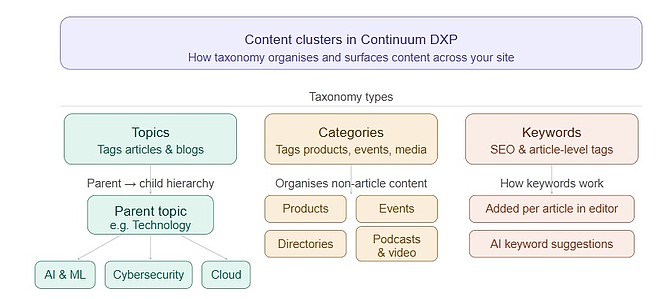
At its core, a content cluster is an intentional architecture. You build one comprehensive topic page around a broad topic — think of it as your definitive statement on a subject. Then you surround it with a constellation of cluster content: focused, in-depth articles that each explore a specific subtopic. Every piece links back to the topic, and the topic links out to each cluster page. It's a web of interconnected, mutually reinforcing content.
The logic behind it is elegant. Search engines like Google have evolved far beyond matching keywords. They're evaluating topical authority — does this site deeply understand the subject it's writing about? A single great article can rank well. But a thoughtfully constructed cluster of 10, 15, or 20 pieces that collectively cover a topic from every angle? That signals expertise at a completely different level.
The results speak for themselves. Brands that adopt content cluster strategies consistently see improvements in organic rankings, lower bounce rates, and longer time-on-site. When your content is architecturally sound, users don't just read one article — they go on a journey through your site.
Here's the part that keeps me up at night as a product leader.
The content cluster model makes complete sense on a whiteboard. Draw a hub-and-spoke diagram in a strategy meeting, and everyone nods. But then the team goes back to their CMS — and the tools often work against them.
Most content management systems were built around a simple, flat content model: you create a page, you publish a page. There's no native concept of a relationship between pieces of content. No way to visually map how your topic page connects to its cluster articles. No structured workflow to ensure that every new cluster piece is properly linked before it goes live. No dashboard that shows you which topics have strong cluster coverage and which have gaps.
So what happens? Strategy gets diluted in execution. Internal links get forgotten. The topic page gets published, but the cluster never fully develops. The architecture that makes the whole model work falls apart in the day-to-day grind of content production.
This is a product problem. And it's one we take seriously.
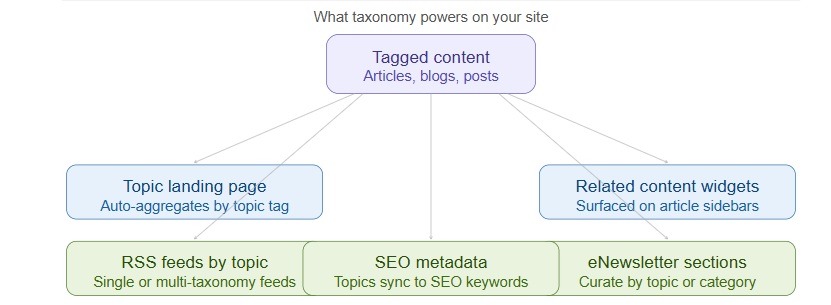
When I think about what great CMS support for content clusters looks like, a few things come to mind immediately.
Visual Content Mapping. Your team should be able to see their content architecture at a glance — which topic pages exist, which cluster articles are live, which are in progress, and where the gaps are. A content map isn't just a planning tool; it's an ongoing operational view that keeps the whole team aligned.
Relationship-Based Content Modeling. Content shouldn't live in isolation. Your CMS should allow you to formally define relationships between pieces — topic to cluster, cluster to related cluster — so that internal linking isn't a manual afterthought but a structured, systematic part of the publishing workflow.
Internal Link Automation and Prompts. When a writer finishes a cluster article, the system should prompt them: "This content relates to your topic page on X — would you like to add the link?" Better yet, it should surface other cluster articles on similar topics so cross-linking happens naturally, not accidentally.
Cluster Health and Gap Analysis. Arguably the most powerful feature. Imagine being able to look at any topic and instantly see: How many cluster pages support it? Which subtopics haven't been covered yet? Which cluster pages haven't been linked? This turns content strategy from a quarterly planning exercise into a continuous, data-informed practice.
Workflow Integration. The best content cluster strategies involve multiple stakeholders — SEO specialists, writers, editors, and subject matter experts. Your CMS should support collaborative workflows that keep everyone aligned on the cluster roadmap without requiring a separate project management tool for every campaign.
I'll be direct: most marketing teams are leaving significant organic traffic on the table because their content infrastructure doesn't support the strategies their marketers already believe in.
Content clusters work. The research backs it up, the logic is sound, and the teams doing it well are seeing real results. The bottleneck isn't conviction — it's execution. And execution lives in your tools.
As a product leader in this space, I believe the next generation of CMS platforms won't just be places where content is stored and published. They'll be intelligent systems that help teams architect content — that make the right structural decisions easier and the wrong ones harder to make by accident.
We're building toward that future. And I'd argue that any content team serious about organic growth should be demanding it from their tools.
If you're a content strategist or marketing leader who understands content clusters but struggles to implement them consistently, I'd encourage you to look critically at your CMS. Ask whether it's actively supporting your strategy or passively getting in the way of it.
Because in the end, a great strategy poorly executed will always lose to a good strategy executed with precision and consistency.
Your content architecture matters. Make sure your tools treat it that way.