News
Publishers bridge gap between content management and AI with Model Context Protocol
March 4, 2026


News
March 4, 2026
Every publisher I talk to has the same story.
They've invested in a powerful CMS. They've built out a content library that spans years of editorial work — articles, media, metadata, taxonomies, the whole architecture. And now they're also investing in AI tools to help their teams move faster, write smarter, and do more with less.
But here's the gap nobody talks about enough: those two worlds don't speak to each other.
AI tools are powerful, but right now most teams are using them like a really smart intern who has to be handed one document at a time. You copy. You paste. You re-explain the context. You lose the metadata. You start over. The AI never gets the full picture, and your team never gets the full benefit.
That's the problem MCP was built to solve.
What Is MCP, and Why Should Publishers Care?
MCP stands for Model Context Protocol — and while that sounds like something your developers care about (they do), the implications are squarely in the publisher's domain.
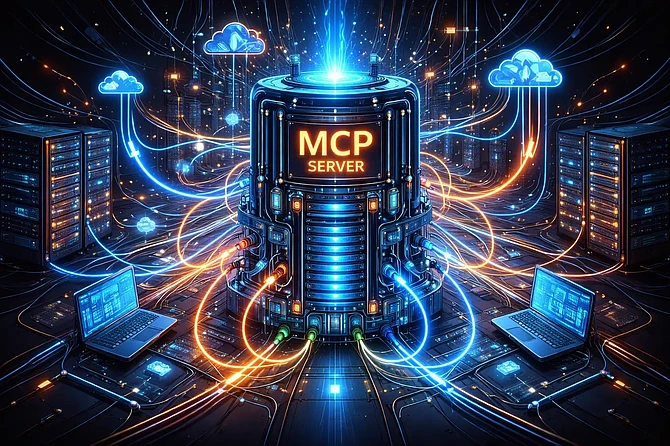
Think of MCP as the connector layer between your AI assistant and your content infrastructure. Instead of handing your AI a document, MCP gives it a key to the filing cabinet. It can find what it needs, understand how your content is structured, and work with it directly — without anyone acting as the middleman.
That means your AI isn't just reading words. It understands your taxonomy. It knows your metadata. It can navigate your content relationships the same way a seasoned editor would after years on the job.
For publishers, that's not a small thing. That's a fundamental shift in what AI can actually do for your operation.
The Workflows That Change First
The most immediate wins aren't the glamorous ones — they're the time sinks your team deals with every single day.
Editorial repurposing. An editor prompts the AI to draft a social media package for a newly published article. With MCP, the AI pulls the piece directly from the CMS, generates platform-specific copy, applies brand voice guidelines, and queues everything for approval. What once took 45 minutes takes two — with no copy-paste and no lost context.
SEO auditing at scale. Instead of a team member manually reviewing months of published content against a keyword strategy, an AI can query the entire CMS, cross-reference it against your target keyword list, and surface a prioritized gap report. Weeks of work becomes a single prompt.
Pre-editorial content checks. Before a draft ever reaches an editor, MCP enables the AI to check it against existing content for duplication, suggest internal links, flag SEO issues, and auto-populate metadata. Every piece arrives at editorial review already optimized.
These aren't hypothetical futures. They're the workflows that become available the moment your AI has structured, permission-aware access to your content systems.
The Bigger Picture: Your CMS as an Active Participant
Here's the strategic framing I'd encourage every publisher to sit with: your CMS has always been a destination. A place content goes to live.
MCP transforms it into a participant.
When a piece publishes, the system doesn't just store it — it can trigger a Slack notification to the relevant team, create a promotion task in your project management tool, and queue a distribution email, all automatically. Your content infrastructure becomes part of a living, connected workflow rather than a static repository.
This matters beyond day-to-day efficiency. The organizations that will get the most out of AI over the next few years won't necessarily be the ones with access to the best models. They'll be the ones whose data is most accessible to those models. Publishers who connect their content ecosystems now are building a structural advantage — not just a productivity boost.
A Note on What Makes This Different
I want to be honest about something: there are a lot of ways to connect AI to content systems. Custom integrations, API stitching, manual workflows — teams find workarounds.
What MCP offers that those approaches don't is standardization. Build the integration once through a single protocol, and it works across every AI application your team uses. Your developers aren't writing one-off connectors for every new tool that comes along. Your editors aren't re-explaining your content architecture to each new AI assistant.
One protocol. Every integration. That's the compounding value over time.
Where to Start
If you're a publisher thinking about where MCP fits into your operation, I'd suggest starting with your most repetitive, highest-volume content workflow — the one where your team loses the most time to manual handoffs and context-switching. That's usually where the ROI is clearest and the adoption is fastest.
From there, the architecture opens up. Analytics integration. Cross-platform publishing. Bulk content migration. Intelligent reporting. Each use case builds on the same foundation.
Your content is already there. Your AI tools are already there. MCP is what puts them in the same room.